Market
Koh Rong's Infrastructure Trajectory: Ferries, the Corridor, and the Airport That Is Not Built Yet
Marketing can say anything; a sealed road either exists or it does not. A sober read of what is built, what is building, and what is still a rendering on Cambodia's most-watched island.
Infrastructure is the only honest forecaster in frontier property. Marketing can say anything, but a sealed road either exists or it does not. Koh Rong's access story sorts cleanly into three piles, built, building, and still a rendering, and keeping them separate is what keeps the underwriting honest.
Built: the corridor that already works
Start on the mainland. An expressway has connected Phnom Penh and Sihanoukville since late 2022, turning the old National Road 4 journey into a reliable two hour drive. Sihanoukville itself holds Cambodia's only deep water port, a special economic zone, and an international airport with regional connections. Since 2025 the capital's long haul gateway has been the new Techo International Airport, which resets the country's inbound capacity for the decade ahead.
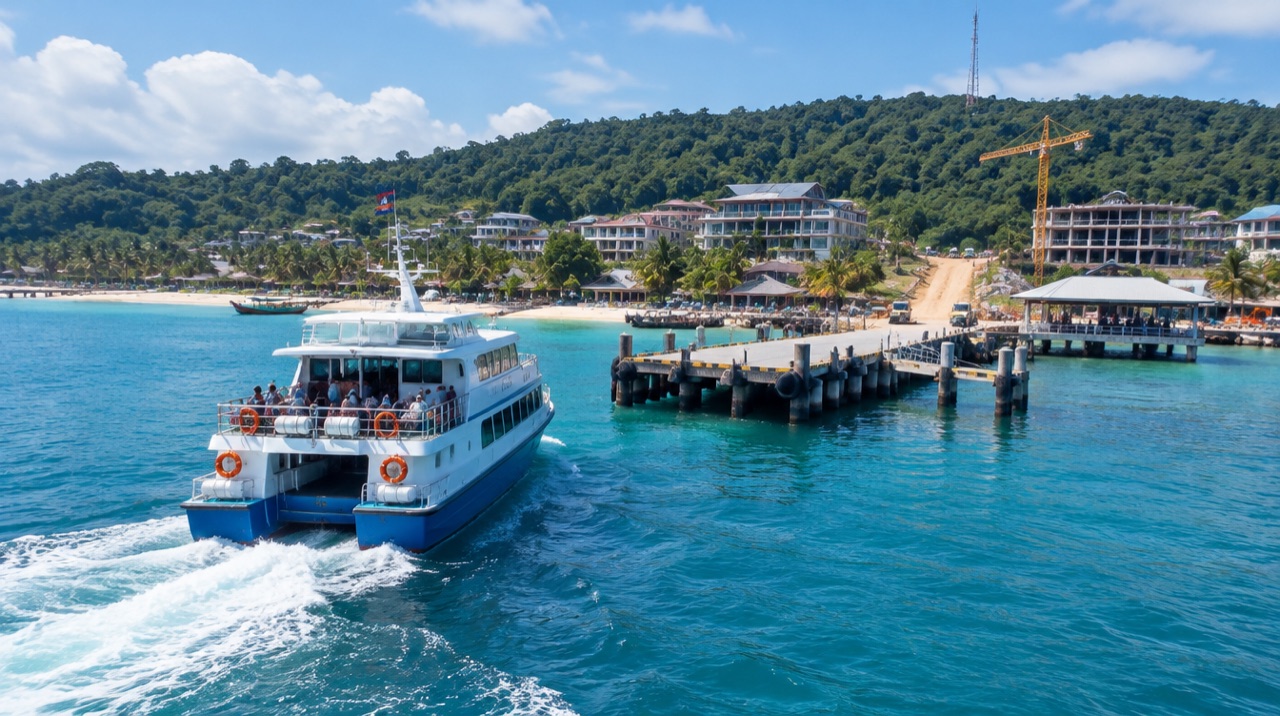
The sea leg is equally real. Scheduled fast catamarans run the roughly 25 kilometres from Sihanoukville to Koh Rong in about 45 minutes, landing mainly at Koh Touch pier with secondary services to Sok San and other beaches. The crossing has been routine long enough that nobody writes about it, which is usually the moment a link starts being priced as permanent. The least photographed item matters most of all: grid electricity reached Koh Rong by submarine cable at the start of the decade, and grid power rather than generators is the difference between a guesthouse economy and a hotel economy.
Building: the island catching up with its coastline
On the island, the visible work is roads. An arterial network is being cut and progressively sealed, including a 30 metre corridor serving the north, the kind of specification that says masterplan rather than village track. Each sealed section turns boat access only land into drive to it land, and the repricing that follows is close to mechanical. Utilities follow the roads, and the practical test for any parcel, whether services are at the boundary or several poles away, keeps moving in one direction.
The hospitality benchmark is building too. The Royal Sands on Sok San Beach set the island's five star reference point, and newer resort products are extending the quality curve. First flags matter, because they anchor the rate expectations that land values later inherit.
Rendering: the airport, treated honestly
A Koh Rong airport has been proposed, planned, and rendered for years within the island's long term development concessions. It is not pure fantasy, since a completed 3.2 kilometre runway already sits up the coast at Dara Sakor waiting for its market. But a disciplined buyer treats an island airport as optionality, not a base case: something you receive for free if it lands, never something you pay for in advance. If a seller prices land off the airport rendering, negotiate off the ferry timetable instead.
What the trajectory means for positioning
Three practical conclusions fall out of the trajectory:
- Buy ahead of the seal, not behind it. The cleanest moves have historically happened as a road section hardens, while prices still reflect the old access.
- Pay for services at the boundary. The discount on land several poles from power tends to evaporate the season the poles arrive.
- The corridor matters more than the island. Koh Rong's demand is manufactured on the mainland, by the expressway, the port, the airports, and the city's own recovery cycle.
None of this requires optimism, only observation: the coastline is fixed, and the distance to it keeps shrinking. Because the island prices land in US dollars, a foreign buyer watches that distance close without local currency risk. This is general market education rather than personal advice. If you want the current state of sealing, utilities, and ferry schedules for a specific stretch of coast, our advisors are glad to help, with no pressure.
Get a personal answer
Ask us anything about the Cambodian market. We answer within one business day, in English, Russian, Chinese or Spanish.
Talk to an AdvisorMarket Insights
 Strategy
Buying in a Down Market: The 2008 Lesson for Phnom Penh
Every cycle, the best entry points feel the most uncomfortable. Here is what the recovery after 2008 can teach a patient buyer looking at Phnom Penh in 2026.
 Strategy
The Patient Capital Playbook: How to Buy Through a Property Downturn
A calm, repeatable method for deploying capital in a falling market. It rests on preparation, a margin of safety, and a hold measured in years rather than months.
 Strategy
Why Cash Buyers Have the Advantage in a Soft Market
When credit tightens and confidence drains away, liquidity becomes the scarcest asset in the room. Here is how cash converts into speed, certainty, and a better price.