Market
Steung Meanchey Real Estate: Reading the Signal Before the Price
A school built for children from Phnom Penh's former Steung Meanchey dumpsite was just named the world's top STEM school. For an investor, that is a data point about direction, not a feel-good headline.
The Neeson Cripps Academy, built to teach children from the community around Phnom Penh's former Steung Meanchey dumpsite, has been named the world's top STEM school at the inaugural Global Schools Prize in London. The landfill stopped taking the capital's waste around 2009, when the city moved its garbage south to Dangkor. The same ground that was once a byword for hardship now sends students onto an international stage.
For anyone studying Steung Meanchey real estate, the prize is worth more than a warm headline. It is a reading on direction.
A district that changed under its own name
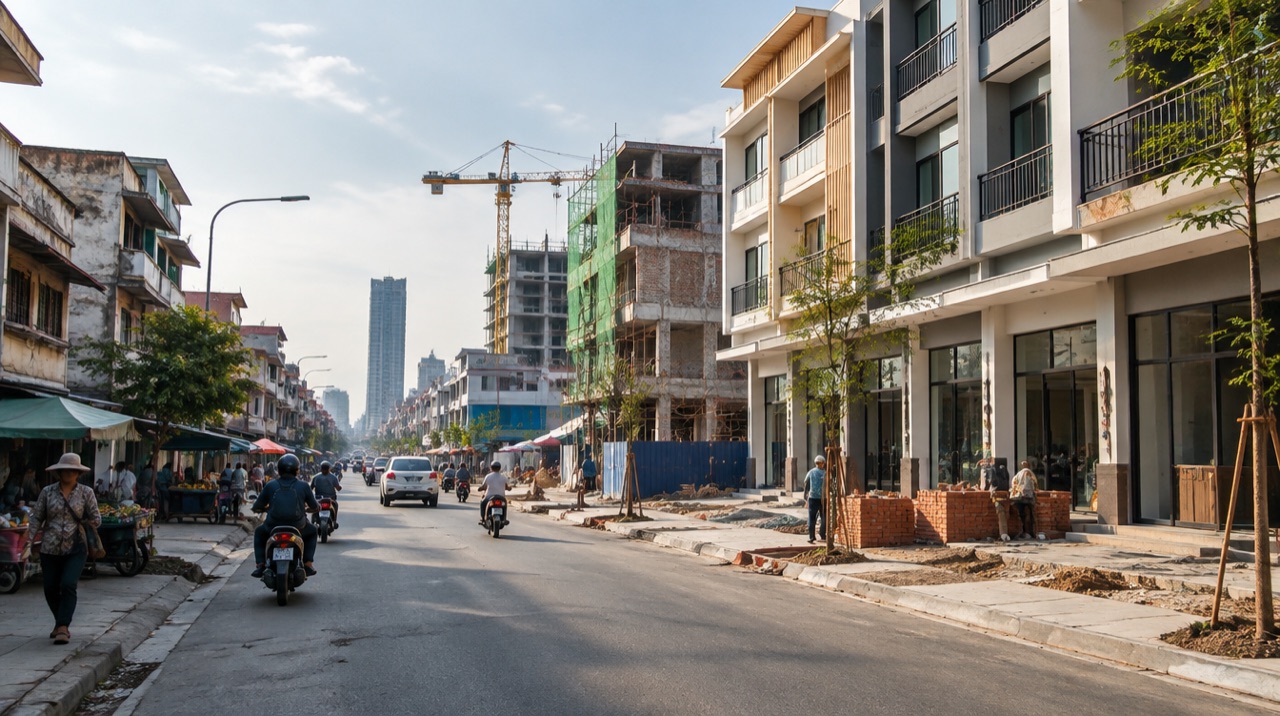
Steung Meanchey sits in the southern reach of Phnom Penh, inside Meanchey, one of the city's most populated districts and a part of the map most foreign capital never visited. For more than a decade the area carried one association, and it lingered long after the trucks stopped. Names outlast facts. What followed rarely makes a brochure. Roads were paved, drainage went in, garment factories and worker housing filled the blocks, and schools and clinics arrived behind the people. None of it was dramatic on any single day. Over fifteen years it added up to a different district wearing an old name.
The wider geography reinforced the shift. Southern Phnom Penh became the city's growth axis, anchored by ring road construction and, more recently, the new airport to the south that pulls activity toward the bottom of the map. A district once treated as the edge now sits closer to where the city is actually heading.
Read a market by its institutions
Investors tend to read a market in a fixed order: price, then yield, then supply, then sentiment. Human capital sits near the bottom of the list, if it appears at all. In a developing city that order is backward. The forces that make land valuable over a generation are rarely on a listing. They are schools that produce graduates who stay, institutions that attract talent rather than export it, and families who decide a neighborhood is worth raising children in. These signals show up years before they are priced, which is exactly what makes them useful. By the time a district's reputation catches up to its reality, the entry point has usually moved.
What the award actually measures
The easy reading is sentiment, and sentiment fades. The structural reading lasts longer. An award like this measures institutions: teaching, retention, outcomes, the slow accumulation of competence that cannot be assembled in one budget cycle. A tower can be financed in eighteen months. A functioning school takes a decade and cannot be bought off a shelf. When that kind of institution takes root in a district the market still discounts, the distance between perception and fundamentals is the whole story. That is the difference between buying a location and buying a direction. Locations are priced efficiently because everyone can see them. Directions are not, because most buyers wait for proof, and proof arrives late.
How a long-horizon buyer uses a story like this
The instinct in a rising market is to act on the headline. The discipline is to act on the pattern the headline belongs to. One school does not reprice a district. A steady arrival of institutions, infrastructure and settled population does, and a single award is best read as one mark on that longer instrument. The work at this stage is quiet.
- Track which districts are gaining schools and clinics, not only condominiums.
- Watch which roads are being widened and where new drainage and power go in.
- Notice where workers are choosing to live rather than merely commute.
- Treat institutions, which compound slowly, as a leading signal rather than a lagging one.
The story in Steung Meanchey is not that land is cheap. It is that the district has spent fifteen years building the one thing a market cannot manufacture on demand. In a 2026 market that has reset lower, patient early reading of that kind of signal is where the durable decisions tend to get made, and no outcome is guaranteed. Investors who learn to read human capital before prices move usually spend less time chasing later.
This is general market education, not personal advice. If you want to read a southern district by its institutions and not only its listings, our team is happy to talk it through, with no pressure to buy.
Get a personal answer
Ask us anything about the Cambodian market. We answer within one business day, in English, Russian, Chinese or Spanish.
Talk to an AdvisorMarket Insights
 Strategy
Buying in a Down Market: The 2008 Lesson for Phnom Penh
Every cycle, the best entry points feel the most uncomfortable. Here is what the recovery after 2008 can teach a patient buyer looking at Phnom Penh in 2026.
 Strategy
The Patient Capital Playbook: How to Buy Through a Property Downturn
A calm, repeatable method for deploying capital in a falling market. It rests on preparation, a margin of safety, and a hold measured in years rather than months.
 Strategy
Why Cash Buyers Have the Advantage in a Soft Market
When credit tightens and confidence drains away, liquidity becomes the scarcest asset in the room. Here is how cash converts into speed, certainty, and a better price.