Districts
Toul Kork Investment Analysis: What the Airport Move Changes
How Phnom Penh's airport relocation reshapes rental demand and capital values in Toul Kork, and what resale buyers should examine before signing.
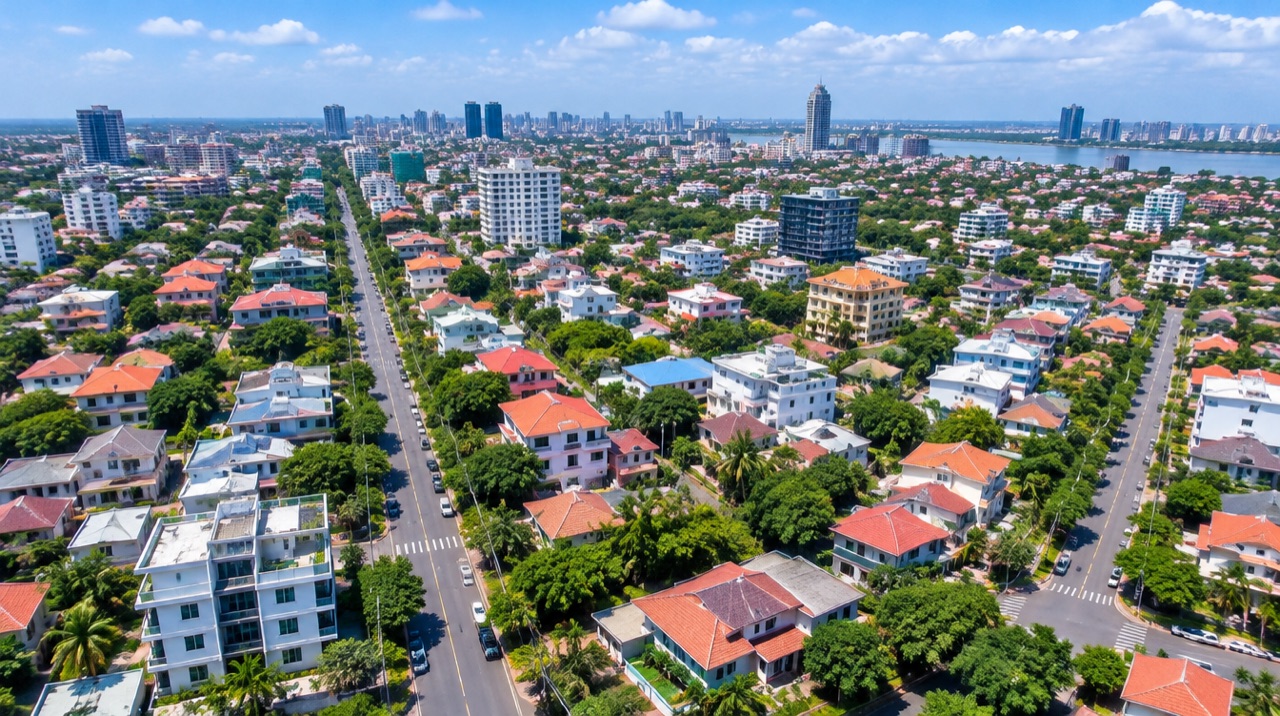
Phnom Penh's centre of gravity is moving. The new international airport sits more than an hour from Toul Kork, the district that has housed the city's professional class for close to two decades. The schools, the hospitals, and the senior expatriate offices are mostly still here. The infrastructure that once justified being here is not. The question for anyone holding or buying in Toul Kork is simple. When a city's economic geometry shifts, how long does the residential premium hold?
The geography problem
For most of the past decade Toul Kork's case was straightforward. Quieter than the centre, residential in character, ringed by international schools, private hospitals, and serious dining, and a short drive to the old airport. The old airport was woven into the city. The new one is not. A regional director who used to budget half an hour for a flight now budgets far more, and multiplied across a year that time starts to bend decisions about where to live.
The sticky ecosystem
The institutions that drew professionals to Toul Kork have not moved, and most of them cannot. International schools do not relocate. Major private hospitals do not relocate. Families with school-age children are the least mobile residents in any city, and the Toul Kork school cluster is still the most established in Phnom Penh, which puts a real floor under rental demand. The open question is whether new arrivals choose the district as readily as those who came before the airport moved.
What resale buyers should examine now
- Parking. With car dependence rising rather than falling, secure off-street parking is a pricing variable, not a feature. Buildings without proper ratios will watch their tenant pool narrow over time.
- In-building services. As the commute to the new commercial core lengthens, residents spend more time at home, so a gym, work-from-home space, and ground-floor food and beverage act as substitutes for walkability.
- Security and the street after dark. Walk the immediate blocks at night, and check access control, lobby staffing, and parking security. These details age far better than a rooftop pool.
Our honest read is that capital appreciation is unlikely to lead the city here over the next cycle, since the headline buyer is now looking at the airport corridor and the southern expansion. Rental yields may prove more durable, precisely because the anchors do not move. Expect steadier income, slower price growth, and a widening gap between well-specified buildings and weak ones. In Toul Kork the investment thesis is no longer the district. It is the building inside it, and on the resale market that distinction is where the returns are decided.
Get a personal answer
Ask us anything about the Cambodian market. We answer within one business day, in English, Russian, Chinese or Spanish.
Talk to an AdvisorMarket Insights
 Strategy
Buying in a Down Market: The 2008 Lesson for Phnom Penh
Every cycle, the best entry points feel the most uncomfortable. Here is what the recovery after 2008 can teach a patient buyer looking at Phnom Penh in 2026.
 Strategy
The Patient Capital Playbook: How to Buy Through a Property Downturn
A calm, repeatable method for deploying capital in a falling market. It rests on preparation, a margin of safety, and a hold measured in years rather than months.
 Strategy
Why Cash Buyers Have the Advantage in a Soft Market
When credit tightens and confidence drains away, liquidity becomes the scarcest asset in the room. Here is how cash converts into speed, certainty, and a better price.