Market
What Cambodia's Railway Revival Signals to Property Buyers
Japanese railcars, a four billion dollar Phnom Penh to Poipet line and new corridors are redrawing where land value will settle. We read the map early.
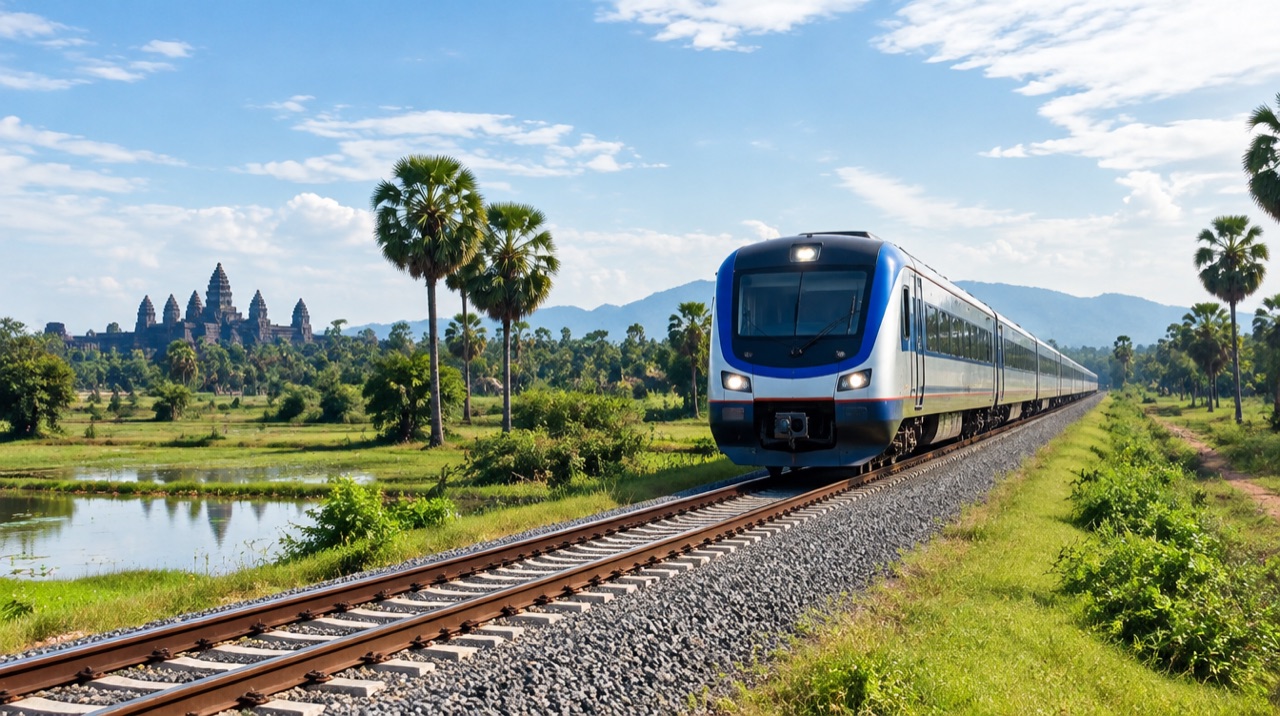
In 2025 Cambodia's railway carried about 400,000 passengers. Buses and taxis moved more than 20 million people in the same year, and roughly seven million flew. Read quickly, those numbers look like a verdict on rail. Read properly, they describe the size of the runway. For a buyer, the question is never where a market sits today but where the capital, the policy and the concrete point next, and in Cambodia an unusual amount of all three points at the tracks.
A quiet signal: the second hand fleet
In April 2024 Royal Railway brought in eleven used KiHa 183 diesel railcars from Japan's JR Hokkaido, regauged them to Cambodia's 1,000 millimetre network and put them into service. By late 2024 they were running, air conditioned, between Phnom Penh, Kampot, Kep and Sihanoukville at fares close to the price of lunch, around four to eight dollars. Buying proven rolling stock late in another country's depreciation curve is a capital efficient move, and a telling one. It rebuilds the demand side, teaching riders to treat the train as a real option well before the expensive lines exist. The binding constraint now is frequency, a single daily departure, and frequency is far cheaper to solve than track.
The line that does not exist yet
The headline project is the Phnom Penh to Poipet line, 382 kilometres to the Thai border, studied by China Road and Bridge Corporation and costed above four billion dollars. The design is a full rebuild, standard gauge, electric trains near 160 kilometres an hour, with 33 stations. The northern run to Battambang takes more than six hours today, yet at that speed the border becomes a few hours away, the threshold where a provincial town starts to behave as an extension of the capital. Parallel studies cover the southern line to Sihanoukville and, further out, a Poipet to Phnom Penh to Bavet corridor between Thailand and Vietnam. The same contractor built the Sihanoukville expressway that opened in 2022 and is building the Bavet expressway due in 2027.
A railway map is a real estate map drawn a decade early.
What the corridor does to land
The value of a railway to a property buyer is not the train, it is the corridor the train certifies. A line compresses the time between two points and widens the radius of land a city can absorb, so ground once too far to price as urban becomes commutable. This is land value capture, and it begins the day the route is drawn rather than the day the first train runs, because the route removes the uncertainty that is the largest discount in any frontier price. Not every corridor rewards the same buyer, since a border line is first a logistics and industrial land story while the southern and coastal stretches run on people and tourism. The transport master plan to 2033 targets 1.5 million rail passengers by the end of the decade, each figure small today and each describing a direction. We map these corridors against land before a client commits, which is the work that rewards patience and punishes haste.
Get a personal answer
Ask us anything about the Cambodian market. We answer within one business day, in English, Russian, Chinese or Spanish.
Talk to an AdvisorMarket Insights
 Strategy
Buying in a Down Market: The 2008 Lesson for Phnom Penh
Every cycle, the best entry points feel the most uncomfortable. Here is what the recovery after 2008 can teach a patient buyer looking at Phnom Penh in 2026.
 Strategy
The Patient Capital Playbook: How to Buy Through a Property Downturn
A calm, repeatable method for deploying capital in a falling market. It rests on preparation, a margin of safety, and a hold measured in years rather than months.
 Strategy
Why Cash Buyers Have the Advantage in a Soft Market
When credit tightens and confidence drains away, liquidity becomes the scarcest asset in the room. Here is how cash converts into speed, certainty, and a better price.