Buying Guide
When Not to Buy Off-Plan in Phnom Penh
Five conditions a disciplined buyer checks before signing an off-plan contract in Phnom Penh, and why a thin discount is a risk you are not paid to take.
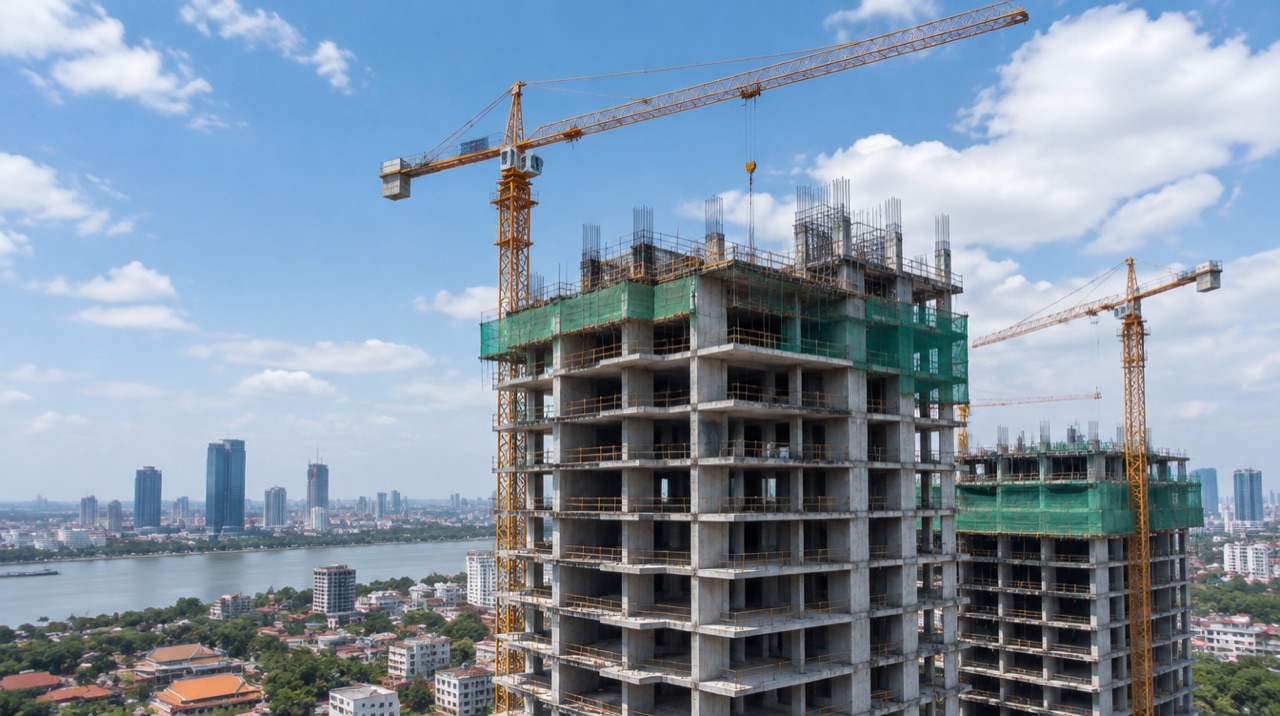
An off-plan buyer usually commits 20 to 30 percent of the price at signing, then pays a further 40 to 60 percent in instalments while the building is still going up. By the time the keys exist, most of the capital is already spent. That single fact, more than location or finish or projected yield, makes off-plan a different instrument from any completed property. You are not buying an apartment. You are financing its construction and carrying the risk between the contract and the handover. Most off-plan coverage is written to help people say yes. This is written to help you know when to say no.
When construction-cost risk is unpriced
Off-plan prices a property today for delivery two or three years out, and in that window someone carries the risk that building costs rise. On paper it is the developer. In practice the pressure lands in one of three places: finishes thinner than the render, a timeline that slips quarter after quarter, or a developer who runs short of capital before the top floor is poured. The disciplined question is whether the developer has locked its cost base or is quietly hoping the numbers hold. A buyer who does not even ask is not investing. They are guessing.
When you cannot underwrite the developer
Off-plan is a bet on delivery, and delivery is a function of the developer, not the drawings. A completed comparable tells you what you are getting. A render tells you what you are being promised. How many projects has the name finished, did they hand over on time, and did the delivered units match what was sold. A first project from an untested developer, sold on a discount, is not a bargain. It is a discount priced to offset a risk you have no way to measure. When you cannot underwrite the builder, the right number of units to buy is zero.
When the maths or your timeline says no
- The discount is thin. Compare the off-plan price with the resale price of a completed unit of similar quality nearby. If the gap is narrow, you are carrying two to three years of risk for a reward already competed away, and a completed unit you can inspect and rent is the better position.
- Your capital cannot sit still. Handover dates are targets, not guarantees. If the money is earmarked elsewhere, must earn on a fixed schedule, or a delay would force a sale at a loss, the instrument is wrong however good the pricing looks.
- You are buying the render. If the case rests on how the marketing makes you feel rather than the location, the floor plate, the developer, and the price against completed stock, slow down. Only the fundamentals still matter at handover.
Off-plan is neither risky nor safe as a category. It is a structure that rewards the buyer who reads it and penalises the one who does not. Investors who lose money off-plan rarely lose it at handover. They lose it at signing, on terms and assumptions they never tested. The analysis of when not to buy is the same one we run before a client does buy, and the projects that survive it are usually the ones worth the wait.
Get a personal answer
Ask us anything about the Cambodian market. We answer within one business day, in English, Russian, Chinese or Spanish.
Talk to an AdvisorMarket Insights
 Strategy
Buying in a Down Market: The 2008 Lesson for Phnom Penh
Every cycle, the best entry points feel the most uncomfortable. Here is what the recovery after 2008 can teach a patient buyer looking at Phnom Penh in 2026.
 Strategy
The Patient Capital Playbook: How to Buy Through a Property Downturn
A calm, repeatable method for deploying capital in a falling market. It rests on preparation, a margin of safety, and a hold measured in years rather than months.
 Strategy
Why Cash Buyers Have the Advantage in a Soft Market
When credit tightens and confidence drains away, liquidity becomes the scarcest asset in the room. Here is how cash converts into speed, certainty, and a better price.