Districts
Where Phnom Penh Real Estate Sits in the Global Cycle
Trend charts show where money has already been. Phnom Penh sits earlier in the same arc: strong yields, dollarised pricing, and districts not yet priced in.
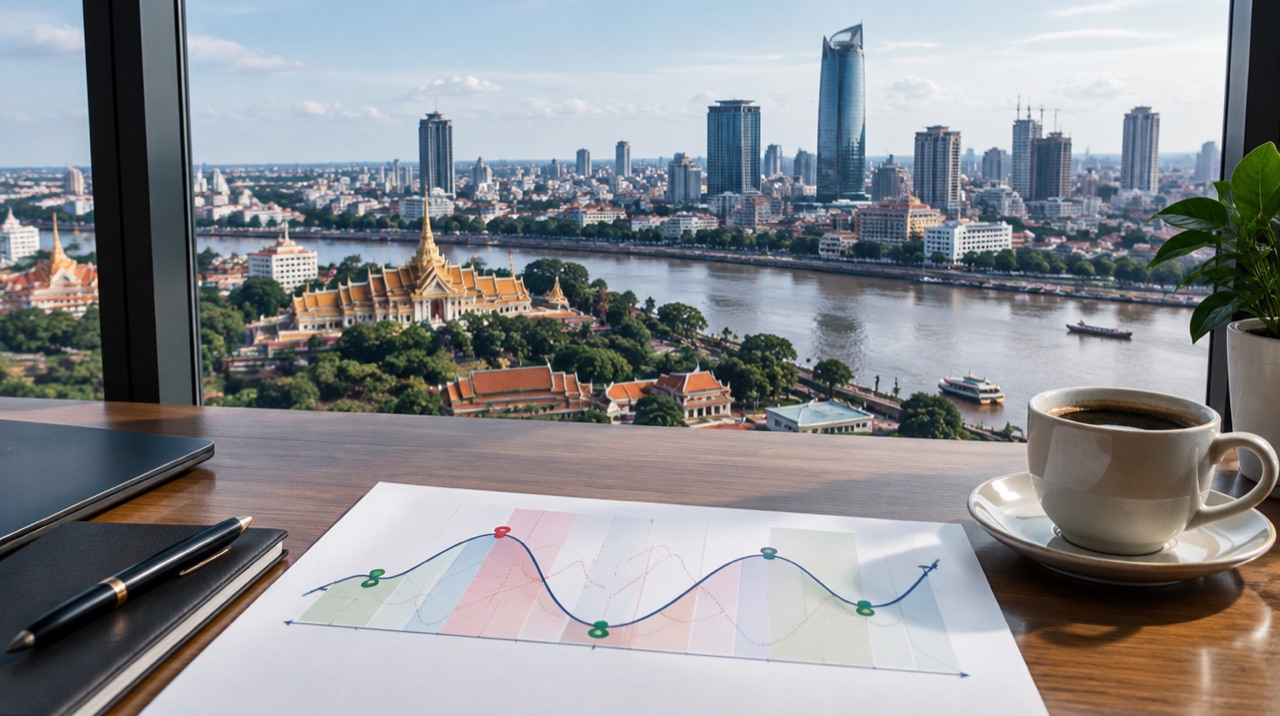
Each year a widely shared chart ranks the world's prime property markets by price growth, and in 2025 Tokyo led it with an exceptional one-year jump, with Dubai and a cluster of Asia-Pacific cities close behind. Phnom Penh did not appear anywhere on the list. For a foreign buyer, that absence is the first thing worth noticing.
What a price-growth chart measures
A ranking of price growth is a record of decisions already made. It shows where capital arrived, competed and pushed values up over the previous year, so by the time a city prints a headline gain, the entry point that produced it closed two or three years earlier. What such markets share underneath the number is scarce quality stock, pricing once accessible to outside capital, and a reputation for stability, and that capital is mobile by design, moving toward conditions rather than postcodes. The money that drove the 2025 surge is already hunting the same setup somewhere cheaper.
The city at the top of the chart is not the opportunity. It is the proof.
Where Phnom Penh sits
Phnom Penh sits at the opposite end of the same arc. The market completed a long repricing after its last peak and has spent the years since building a floor rather than chasing records, which is exactly why it is missing from a chart of realised gains. Growth is forecast around 4 to 5 percent for 2026, well above the global average near 2.6 percent, and gross rental yields in established central districts still run in the strong single digits, a spread mature Asian capitals gave up years ago. The more telling numbers are one ring out, in older neighbourhoods such as Tuol Tompoung, where well-bought resale stock can run higher still because the market has not fully priced it in.
The structure behind the price
Two advantages the headline markets cannot match sit underneath this. Cambodia runs a dollarised economy, so a buyer holding dollars carries no currency timing risk, and foreign nationals can hold freehold title to strata units outright. Connectivity is turning the setup into a trend, with the new Techo International Airport opening in 2025 and upgraded rail now linking the capital to the coast and the Thai border, each corridor putting a floor under land values along its length. The position worth holding is the one the chart teaches, applied to the street: buy a district before it earns its reputation. We help foreign buyers find those districts across resale, off-plan and auction stock, before they reach anyone's ranking.
Get a personal answer
Ask us anything about the Cambodian market. We answer within one business day, in English, Russian, Chinese or Spanish.
Talk to an AdvisorMarket Insights
 Strategy
Buying in a Down Market: The 2008 Lesson for Phnom Penh
Every cycle, the best entry points feel the most uncomfortable. Here is what the recovery after 2008 can teach a patient buyer looking at Phnom Penh in 2026.
 Strategy
The Patient Capital Playbook: How to Buy Through a Property Downturn
A calm, repeatable method for deploying capital in a falling market. It rests on preparation, a margin of safety, and a hold measured in years rather than months.
 Strategy
Why Cash Buyers Have the Advantage in a Soft Market
When credit tightens and confidence drains away, liquidity becomes the scarcest asset in the room. Here is how cash converts into speed, certainty, and a better price.