Market
Northern Phnom Penh Property: Why the Fast Gains Moved South
Sen Sok and Chroy Changvar have matured into good places to live, which is a different thing from places where capital still moves fast. Here is where the gains went and the real cost of distance.
On 9 September 2025, Phnom Penh's main gateway moved. Techo International Airport opened about 20 kilometers south, in Kandal, replacing the airport that had served the capital from the west for close to seventy years. Cities tend to grow toward their newest infrastructure, not away from it, and the capital now has a clear direction of travel.
For northern Phnom Penh property, from Sen Sok across to the Chroy Changvar peninsula, that reframes the question. These districts were, for a while, where ambitious buyers looked first. They are still good places to live. Whether they are still places where capital appreciates quickly is a separate question, and the honest answer has changed.
What the north still does well
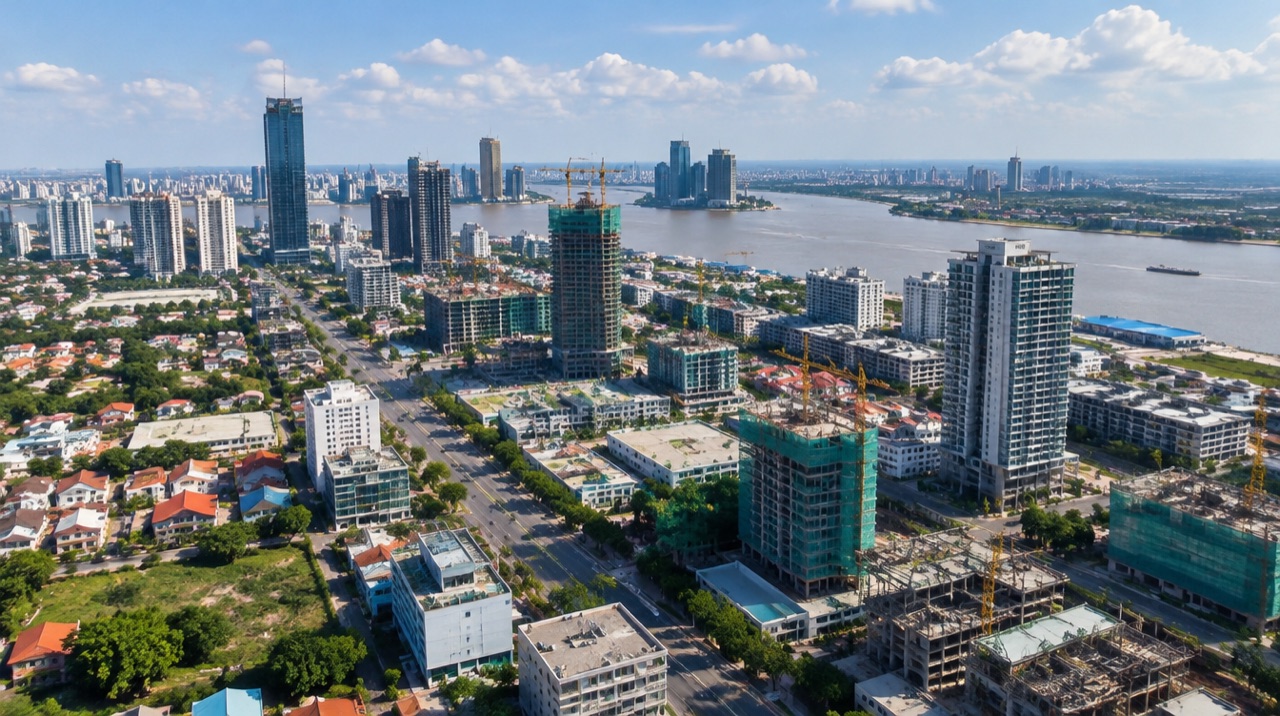
Sen Sok and Chroy Changvar have finished a cycle. The roads are in, the schools and malls are built, and the bridges that once made Chroy Changvar feel like a frontier now make it an ordinary commute across the Tonle Sap. What was raw land under a masterplan a decade ago is a working residential city, lived in mostly by people who intend to stay. That is not decline, it is maturity, and the two get confused constantly. An area can be excellent to live in and modest to speculate on at once, because those are two products sold to two different buyers. Owner-occupier demand anchors prices. It rarely launches them.
The axis has a direction now
The clearest signal is where the next dollar of infrastructure goes. The new airport sits south. The Hun Sen Boulevard extension that feeds it runs south. The planned airport city and the discussed light rail toward the Aeon mall in Meanchey both point south. The northern corridor is served. The southern corridor is being built. First-wave appreciation tends to attach to the frontier, not the finished district. That is not a judgment on the north's quality. A completed neighborhood with reliable services is worth more to a resident than a construction site, but a buyer looking for the repricing that comes when infrastructure arrives has to look where it is arriving.
The cost that never appears on the price sheet
Here is the part most buyers skip. They price the unit. Almost no one prices the distance. A unit is bought once. Its location is paid for every morning. From much of the northern corridor into the central work districts, a peak-hour commute can run an hour or more each way, which is time, fuel and vehicle wear, recurring and uncounted.
The recent market showed why that matters. Cambodia imports effectively all of its fuel, so a surge in global oil prices passed straight through to local pumps. By April 2026 headline inflation had reached 5.79 percent year on year, with transport costs up 9.72 percent the single largest driver, and regular gasoline up more than 40 percent from its earlier level. Forecasters expect energy to ease, with oil near 96 dollars a barrel in 2026 and 80 in 2027 and inflation drifting back toward 2.5 percent, but the number will move while the exposure stays. A buyer far from the center is quietly long oil. Distance turns a global price swing into a monthly household bill whether the household planned for it or not.
How a professional prices distance
The fix is not to avoid the north. It is to be honest about which buyer you are. Three buyers show up for the same unit, and the district fits them differently.
- The capital-appreciation buyer wants the price to move, and the north is a poor fit for that today.
- The yield buyer wants cash flow from local tenants at resident economics, and the north serves that well because the demand is real and stable.
- The owner-occupier wants a home, and if the commute genuinely works for their life and fuel budget, the north is among the better-value places to buy one.
Buying in the north is not a mistake. Buying there while expecting fast capital gains, or while ignoring the fuel bill attached to the distance, is a mismatch of product to expectation. The risk was never the district. It was the reason for buying it. Because the economy is dollarized, the variable a foreign buyer is really taking on here is location, not currency, and in a 2026 market that has already reset lower, separating where you want to live from where you want your money to work matters more than ever.
This is market education, not personal advice, and no outcome is guaranteed. If you want the daily cost of distance built into the numbers before you choose an address, our team is glad to run it with you, with no pressure to buy.
Get a personal answer
Ask us anything about the Cambodian market. We answer within one business day, in English, Russian, Chinese or Spanish.
Talk to an AdvisorMarket Insights
 Strategy
Buying in a Down Market: The 2008 Lesson for Phnom Penh
Every cycle, the best entry points feel the most uncomfortable. Here is what the recovery after 2008 can teach a patient buyer looking at Phnom Penh in 2026.
 Strategy
The Patient Capital Playbook: How to Buy Through a Property Downturn
A calm, repeatable method for deploying capital in a falling market. It rests on preparation, a margin of safety, and a hold measured in years rather than months.
 Strategy
Why Cash Buyers Have the Advantage in a Soft Market
When credit tightens and confidence drains away, liquidity becomes the scarcest asset in the room. Here is how cash converts into speed, certainty, and a better price.