Buying Guide
Why Listing Photos Mislead Buyers, and How to Read the Floor Plan Instead
Wide lenses, undersized staging, and a single flattering moment of light make rooms look bigger than they live. Here is how to read past the picture to the plan.
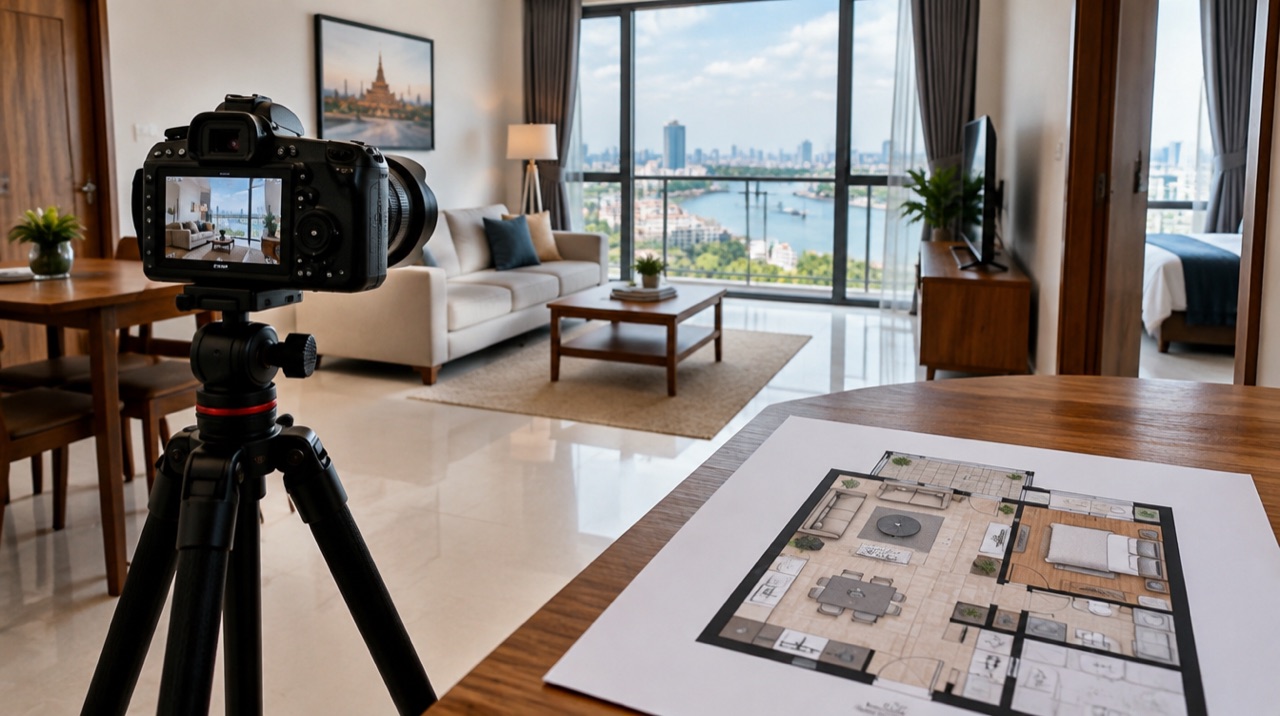
Most property listing photos are shot on a lens somewhere between 14 and 16 millimetres, wide enough to make a 40 square metre apartment read closer to 60. That is not a flaw in the picture. It is the point of it. The camera is doing exactly what it was hired to do, which is to show the room as its most generous self. The trouble starts when a buyer treats that picture as a preview instead of a sales argument.
There is a steady gap between how a space looks in a frame and how it feels in a life. Some of the most photogenic interiors are hard to actually live in, and some of the plainest listings hide apartments that feel effortless the moment you step inside. Learning to tell the two apart is most of the skill.
What the wide lens is doing to the room
A wide angle lens exaggerates depth. Objects near the camera stretch, walls seem to pull apart, and a corridor you cross in three steps photographs like a gallery. Straight lines near the edge of the frame bow slightly outward, and that is the tell. If the door frames or window mullions in a listing curve, the shot was taken wide and the room is smaller than it looks.
Furniture adds to the effect. Staging companies often use pieces scaled below normal residential size, sofas shorter than the ones people own, beds that photograph like queens but measure closer to doubles. Dropped into an empty apartment and shot from the corner, undersized furniture makes the space around it read as larger than it is.
The things a photo can never hold
A photograph captures one instant of light. A north facing living room in Phnom Penh gets usable daylight for only a narrow part of the day, and a good photographer shoots it precisely then. The image is honest about that moment and silent about the other twenty three hours. Light is the hardest quality to read from a listing and the single biggest driver of how a room feels to live in.
The same goes for everything a still frame cannot carry. Acoustics do not photograph. Heat does not photograph. The noise of the boulevard four floors down, the way the afternoon sun loads up under a low western window, the echo in a hard room with no soft furnishing, all of it is invisible in the picture and unavoidable once you move in.
Circulation is the quality you cannot see
Livability is mostly circulation, and circulation is exactly what a photograph is worst at showing. A photo is a fixed point. Living in a space is movement through it: the path from the door to the kitchen, whether the bedroom door swings into the only place the bed can go, whether the dining table blocks the balcony once it is actually set. A passage narrower than about 0.9 metres forces two people to turn sideways to pass, and no listing image will tell you that. A scaled floor plan will, because a plan is drawn to measure and cannot flatter.
How to test an image before you commit
A few habits separate the buyers who read photographs from the buyers who get read by them.
- Check the verticals. Bowing lines mean a wide lens and a smaller room than the frame suggests.
- Scale against fixed elements. An interior door is about 0.9 metres wide and a little over 2 metres tall, so measure the furniture against the door, not against the room.
- Ask when the light shot was taken, then ask to see the room at a different hour. A seller confident in the light will not hesitate.
- Ask for the dimensioned floor plan and walk it in your mind, from the door to the bed, the kitchen to the table, the sofa to the balcony.
For off plan purchases the discipline matters more, not less. A render is a picture of something that does not exist yet, produced by people whose job is to make it desirable before it is buildable. It is the least reliable document in the deal. The floor plan, the ceiling heights, the specification schedule, and the material list are the reliable ones. Read those.
Phnom Penh's 2026 market has reset lower, with more motivated sellers and more ready, clean title units changing hands, which makes this plain discipline worth more rather than less. Buyers who read the plan before the photo tend to make fewer expensive corrections later. If it helps to have a second read on a floor plan or a set of renders before you commit, our advisors are glad to go through them with you, with no pressure either way.
Get a personal answer
Ask us anything about the Cambodian market. We answer within one business day, in English, Russian, Chinese or Spanish.
Talk to an AdvisorMarket Insights
 Strategy
Buying in a Down Market: The 2008 Lesson for Phnom Penh
Every cycle, the best entry points feel the most uncomfortable. Here is what the recovery after 2008 can teach a patient buyer looking at Phnom Penh in 2026.
 Strategy
The Patient Capital Playbook: How to Buy Through a Property Downturn
A calm, repeatable method for deploying capital in a falling market. It rests on preparation, a margin of safety, and a hold measured in years rather than months.
 Strategy
Why Cash Buyers Have the Advantage in a Soft Market
When credit tightens and confidence drains away, liquidity becomes the scarcest asset in the room. Here is how cash converts into speed, certainty, and a better price.